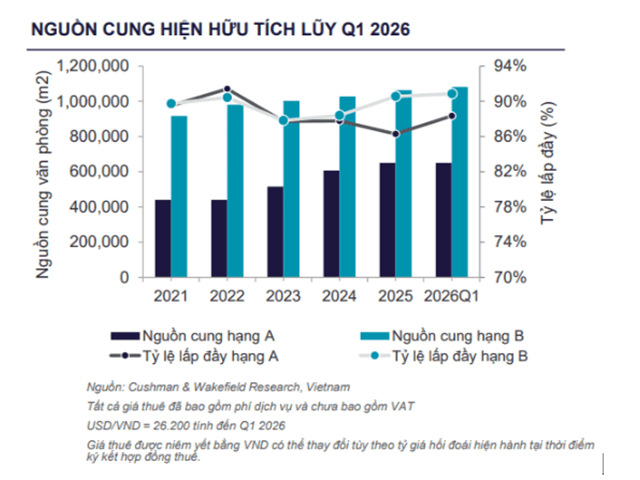
Nửa đầu năm 2026 đã vẽ nên một bức tranh khá đặc sắc về thị trường cho thuê văn phòng tại Thành phố Hồ Chí Minh. Trong khi nguồn cung mới tiếp tục mở rộng, giá thuê nhìn chung vẫn ổn định. Tuy nhiên, đằng sau thị trường tưởng chừng ổn định này là sự khác biệt ngày càng rõ rệt giữa các khu vực trung tâm thương mại (CBD và các khu vực lân cận) và các quận ngoại ô của thành phố, mỗi khu vực chịu ảnh hưởng bởi những động lực thị trường khác nhau.
Bài viết này cung cấp tổng quan về nguồn cung văn phòng phẩm, giá thuê, tỷ lệ lấp đầy và các xu hướng thị trường chính, đặc biệt tập trung vào sự khác biệt giữa hai lĩnh vực này để giúp các doanh nghiệp đưa ra quyết định thuê văn phòng sáng suốt hơn trong nửa cuối năm.
1. Tổng quan về nguồn cung thị trường: Tăng trưởng chậm hơn ở khu vực trung tâm thành phố, mở rộng mạnh mẽ ở các khu vực ngoại ô.
Đến giữa năm 2026, tổng diện tích văn phòng tại Thành phố Hồ Chí Minh đã vượt quá 7,63 triệu mét vuông. Diện tích văn phòng hạng A và hạng B – phân khúc được các công ty tư vấn bất động sản quốc tế theo dõi sát sao nhất – đạt khoảng 1,74 triệu mét vuông trong quý 1 năm 2026, tăng 5,7% so với cùng kỳ năm trước.
1.1 Khu trung tâm thương mại (Quận 1, Quận 3 cũ và vùng lõi đô thị)
Khu trung tâm thương mại (CBD) vẫn là vị trí văn phòng danh giá nhất thành phố. Tuy nhiên, nguồn cung văn phòng mới đã giảm đáng kể do nguồn cung đất hạn chế và chi phí phát triển tăng cao. Một số tòa nhà văn phòng cũ đã gặp phải tình trạng suy giảm hiệu quả hoạt động, một số tạm thời ngừng hoạt động hoặc được chuyển giao cho chủ sở hữu mới.
Một điểm nổi bật đáng chú ý là việc hoàn thành các dự án cao cấp như Saigon Marina IFC, bổ sung thêm nguồn cung văn phòng chất lượng cao cho trung tâm thành phố.
1.2 Các khu vực ngoại ô và khu vực kinh doanh mới nổi (Thành phố Thủ Đức, Quận 7, Bình Thạnh, phía Đông TP.HCM)
Hầu hết các dự án phát triển văn phòng mới hiện nay đều tập trung bên ngoài khu trung tâm thương mại truyền thống (CBD). Những khu vực này được hưởng lợi từ nguồn đất đai dồi dào hơn, chi phí phát triển thấp hơn và cơ sở hạ tầng liên tục được cải thiện, đặc biệt là việc mở rộng mạng lưới tàu điện ngầm.
Xu hướng này cũng phù hợp với những thay đổi trong yêu cầu của môi trường làm việc, khi các doanh nghiệp hiện đại ngày càng tìm kiếm diện tích sàn lớn hơn và bố trí văn phòng linh hoạt hơn - những đặc điểm khó đáp ứng trong không gian hạn chế về diện tích của trung tâm thành phố.
Nhìn về phía trước, khu trung tâm thương mại (CBD) dự kiến vẫn sẽ đón nhận hơn 100.000 mét vuông không gian văn phòng cao cấp đạt chứng nhận xanh trong năm 2026, cho thấy mặc dù số lượng dự án vẫn còn hạn chế, chất lượng của các công trình phát triển mới vẫn tiếp tục được cải thiện.
2. Giá thuê nhà: Khoảng cách giữa thị trường trung tâm và vùng ngoại ô ngày càng nới rộng
Thoạt nhìn, giá thuê nhà trên toàn thị trường có vẻ tương đối ổn định.
Giá thuê trung bình cho văn phòng hạng A vào khoảng 53,5 USD/m2/tháng, tăng 1,3% so với quý trước nhưng giảm 0,9% so với cùng kỳ năm ngoái.
Giá thuê trung bình văn phòng hạng B là 33,5 USD/m2/tháng, giảm 1,3% so với quý trước và 1,9% so với cùng kỳ năm ngoái, chủ yếu do sự cạnh tranh ngày càng tăng từ các dự án mới bên ngoài khu trung tâm thành phố.
The regional differences become much clearer when broken down geographically.
|
Segment
|
Central Districts (CBD)
|
Fringe Districts
|
|
Grade A
|
USD 62.09/sqm/month
|
USD 40.70/sqm/month
|
|
Grade B
|
USD 44.76/sqm/month
|
USD 28.27/sqm/month
|
Rental rates in the CBD remain approximately 30–35% higher than in fringe locations, reflecting both the scarcity of prime office space and the rapid expansion of supply outside the city center.
Market forecasts for the second half of 2026 indicate that this divergence is likely to continue.
CBD Grade A and Grade B+ offices are expected to increase modestly by 2–4%, with asking rents ranging between USD 45–70/sqm/month due to limited new supply.
Meanwhile, office buildings in fringe districts such as Binh Thanh, former Phu Nhuan, and former Tan Binh are projected to maintain relatively stable rental levels between USD 15–32/sqm/month, although landlord incentives such as rent-free fit-out periods may gradually become less generous as occupancy improves.
An interesting development is the emergence of Xuan Hoa Ward (formerly District 3), where occupancy has reportedly reached approximately 88%, while rental rates remain 15–20% lower than District 1, positioning the area as an attractive middle-ground option.
3. Occupancy Rates: The Gap Is Narrowing
.png)
Perhaps the most notable trend during the first half of 2026 is the convergence in occupancy levels.
Vacancy rates in the CBD remained between 12.3% and 16.5%.
Outside the city center, vacancy improved much more dramatically, declining from 28.5% to only 21.9%.
Although rental rates still differ significantly, occupancy levels between the two markets have become increasingly similar.
Across the city, Grade A and Grade B offices recorded occupancy rates of 88.3% and 90.9%, respectively.
The slight decline compared with earlier periods is largely attributed to tenant relocations rather than weaker demand, as many companies have moved from premium CBD offices to high-quality buildings in fringe locations to optimize occupancy costs while maintaining operational standards.
4. Who Is Leasing Office Space?
Approximately 78% of office transactions during this period were driven by relocation and business expansion rather than first-time leasing.
The industries generating the strongest demand include:
The ICT sector alone accounted for approximately 26–35% of newly leased office space.
Demand for offices in District 1 continues to dominate online searches, demonstrating that the prestige of a central business address remains highly valued.
Nevertheless, businesses seeking better cost efficiency are increasingly willing to relocate to Eastern Ho Chi Minh City and fringe districts, where high-quality Grade B and Grade C office buildings have become attractive alternatives.
Supporting these trends is Vietnam's strong macroeconomic performance.
During Q1 2026, realized foreign direct investment (FDI) reached USD 5.4 billion, the highest first-quarter figure since 2021, while GDP expanded by 7.8%, providing continued momentum for office demand from multinational companies.
5. Three Trends Reshaping the Market
(5).jpg)
Cre: Maison Office
5.1 Transportation Infrastructure Is Narrowing the Location Gap
Office buildings located within 500 meters of Metro Line 1 stations have experienced rental increases of approximately 3–5%, particularly in non-CBD areas.
The market has also begun positioning for Metro Line 2, with locations surrounding key stations such as Pham Van Hai and Bay Hien expected to become the next high-potential office hubs.
5.2 Eastern Ho Chi Minh City Is Being Repositioned
Thu Duc City and District 7 are no longer viewed simply as lower-cost alternatives.
They are increasingly attracting technology companies, manufacturers, logistics operators, and premium office developments thanks to improving infrastructure and regional connectivity.
5.3 Green Buildings Are Reducing the Quality Gap
Approximately 73% of Grade A office buildings in Ho Chi Minh City have now achieved green building certifications.
Virtually all projects completed within the past three years meet green building standards, many of which are located outside the traditional CBD.
As a result, a Grade A green-certified office building in Thu Duc City or District 7 can now compete directly with CBD buildings in terms of operational quality while offering significantly lower rental costs.
6. Outlook for the Second Half of 2026
.png)
Between 2025 and 2027, Ho Chi Minh City is expected to add approximately 287,000–290,000 square meters of new office space, primarily concentrated in Thu Duc City, District 7, and selected parts of District 1.
As competition intensifies among fringe office developments, landlords are expected to continue offering flexible leasing incentives, including rent-free periods, fit-out support, and more flexible lease structures.
In contrast, landlords in the CBD—where supply remains constrained and occupancy stays high—are likely to maintain firmer pricing strategies with fewer incentives.
7. Conclusion: Should Businesses Choose the CBD or Fringe Locations?
There is no universal answer.
For companies whose business relies heavily on prestige, client meetings, and a premium corporate image—particularly those in finance, consulting, and professional services—the CBD continues to justify its rental premium.
However, businesses prioritizing long-term cost efficiency, larger office floor plates, or access to younger talent pools increasingly find high-quality office buildings in Thu Duc City, District 7, and metro-connected districts to be compelling alternatives.
The first half of 2026 demonstrates a maturing office market characterized by controlled supply growth, relatively stable rental performance, and rapidly narrowing quality differences between central and fringe office locations.